Orlando Goñi: The Pianist Who Drove Troilo's First Orchestra
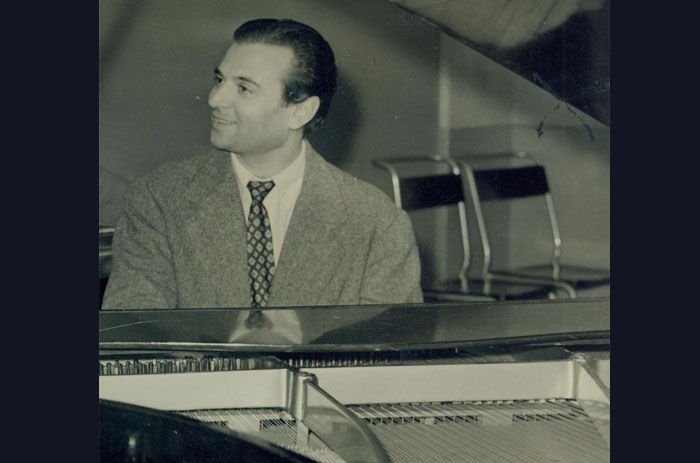
Orlando Goñi lived only thirty years, but his left hand shaped the sound of Aníbal Troilo's first orchestra, and the orchestra he led himself survives on just four private acetates.
At a glance
- Born Orlando Cayetano Gogni in Buenos Aires in 1914 (26 January according to Néstor Pinsón, May according to Juan Ayala); died on 5 February 1945
- Pianist of Aníbal Troilo's orchestra from its debut in 1937 until 1943; 71 recordings with Troilo according to Ayala
- His own orchestra, launched in December 1943, never recorded commercially; four private acetates survive
Fuente original: «Orlando Goñi (El Pulpo del Piano)» (Juan Ayala, Revista Club de Tango, 1995) · Resumen en español ↓
When dancers hear the early recordings of Aníbal Troilo’s orchestra, from 1938 to 1943, part of what drives them is the piano of Orlando Goñi. He was nicknamed El Pulpo del Piano, “the octopus of the piano”, and he died at thirty. In 1995 Juan Ayala wrote a portrait of him for Revista Club de Tango, convinced that Goñi’s stature grows with time and that he was one of the greatest tango pianists. This page follows Ayala’s article and compares it with the biography by Néstor Pinsón on Todotango.
A left hand like guitar basses
Ayala describes a style of pure tango essence. Goñi’s left hand was strong and warm, used like the bordonas, the bass strings of a guitar. Like Pedro Maffia, he was never “square”. His rhythmic marking was milonguera, made for dancing. He could read music but disliked being tied to written arrangements, because he was an intuitive genius who created on the spot. He had syncopation and swing, and admired the jazz pianist Teddy Wilson. Pinsón also hears jazz influence and syncopation in his playing, and says Goñi had an inimitable way of “driving” the orchestra from the piano.
The tango historian Luis Adolfo Sierra, writing about Alfredo Gobbi on Todotango, goes further: the bordoneo style of left-hand marking, he says, was virtually created with Goñi.
Two boys at the cinema
Ayala dates Goñi’s birth to May 1914, the same year as Troilo’s. Pinsón gives 26 January 1914 and his real name, Orlando Cayetano Gogni. They also differ on the start: Ayala has him debut at fourteen with Miguel Caló, Pinsón at thirteen with Alfredo Calabró, after piano and harmony lessons with Vicente Scaramuzza.
Both stress the friendship with the violinist Alfredo Gobbi. Ayala retells a story from Sierra: when Julio De Caro’s sextet played at the Select cinema on Lavalle street, Gobbi, then fourteen, and Goñi, twelve, sat in front and took notes by the light of matches. Gobbi kept the De Caro influence all his life; Goñi took from Francisco De Caro the full sound of the piano. Later Goñi and Gobbi played duos on the radio and formed a sextet with Troilo, Alfredo Attadía, Goñi’s brother José on violin and Luis Adesso on bass.
Many orchestras before Troilo
Ayala lists Goñi’s stops in the early 1930s. In 1931 he was the pianist of a group led by Cayetano Puglisi on Radio Fénix. He met Troilo again in the orchestra of Ciriaco Ortiz on Radio El Mundo, played for a while with Manuel Buzón and, at the 1936 carnival, was second pianist with Francisco Canaro next to the regular pianist, Luis Ricardi. With a quartet he accompanied the singer Enrique Carbel on four recordings; two of them, En un beso la vida and Charlemos, survive. Pinsón adds that Goñi first met Troilo in Buzón’s orchestra and played with him again in 1936 under Juan Carlos Cobián.
Six years with Troilo
In 1937, according to Ayala, it was Goñi who encouraged Troilo to form his own orchestra. Ayala gives the debut as June 1937 at the Marabú cabaret; Pinsón, in his Todotango chronicle of Troilo’s orchestra, gives 1 July 1937 at the Marabú, Maipú 359, with Goñi on piano. Their line-ups differ on the singer: Ayala names Alfredo Lucero Palacios, Pinsón Francisco Fiorentino.
Ayala, without wanting to diminish Troilo, argues that Goñi imposed his personality on the orchestra during his six years in it, and counts 71 recordings with Troilo. Goñi left in 1943 to form his own orchestra, in August according to Ayala and in September according to Pinsón.
The orchestra nobody recorded
Goñi’s own orquesta típica was strong on paper. Ayala lists five bandoneons, among them Antonio Ríos, Roberto Di Filippo and Eduardo Rovira, with Rolando Curzel and José Amatriain among the violins, Domingo Donaruma on bass and a cellist. The singers were Antonio Rodríguez Lesende, Raúl Aldao, Osvaldo Cabrera and, for a short time in 1944, Fiorentino. Pinsón names largely the same musicians and singers.
According to Ayala, the orchestra opened on 1 December 1943 at the Café Nacional and drew 25,000 people in fifteen days. The newspaper El Mundo called Goñi the “marshal of tango”, and Radio Belgrano engaged him in 1944.
No record company signed it, which Ayala blames on the deafness of the labels’ directors. Only four private acetates survive, of poor quality: Agustín Bardi’s El taura, Goñi’s milonga Mi regalo (lyrics by E. Dizzeo, as Ayala spells it, sung by Cabrera), Y siempre igual (sung by Aldao) and Chiqué. Pinsón confirms the four titles and calls Mi regalo Goñi’s only composition. Anyone who listens, Ayala writes, will hear how close they are to the early Troilo sound.
An early death
Goñi died on 5 February 1945. Pinsón writes that his bohemian life burned him out, and that when he knew he was seriously ill he went to Uruguay, where he died at a musician friend’s home; Ayala says it was the house of the Uruguayan bandoneonist Juan Esteban Martínez, a member of his orchestra.
His friend Gobbi remembered him with the tango Orlando Goñi, which Sierra counts among Gobbi’s own compositions. Ayala adds one more trace of his influence: the pianist Osvaldo Tarantino named Goñi as his teacher. Among the tango artists of the 1940s, few left so little on record and so much in the playing of others.
Sources
- Juan Ayala, “Orlando Goñi (El Pulpo del Piano)”, Revista Club de Tango no. 13, March–April 1995. Archived copy on clubdetango.com.ar (archive.org, 2010).
- Néstor Pinsón, “Orlando Goñi”, Todotango (real name, birth on 26 January 1914, Scaramuzza, debut with Calabró, Buzón and Cobián, Troilo until September 1943, his orchestra, the four acetates, Mi regalo, death in Uruguay).
- Néstor Pinsón, “Orquesta Típica Aníbal Troilo”, Todotango (debut on 1 July 1937 at the Marabú, line-up with Goñi and Fiorentino).
- Luis Adolfo Sierra, “Alfredo Gobbi”, Todotango (friendship with Goñi, the bordoneo marking, Gobbi’s tango Orlando Goñi).