La Cumparsita: The Lyrics, the Lawsuits and the Most Famous Tango
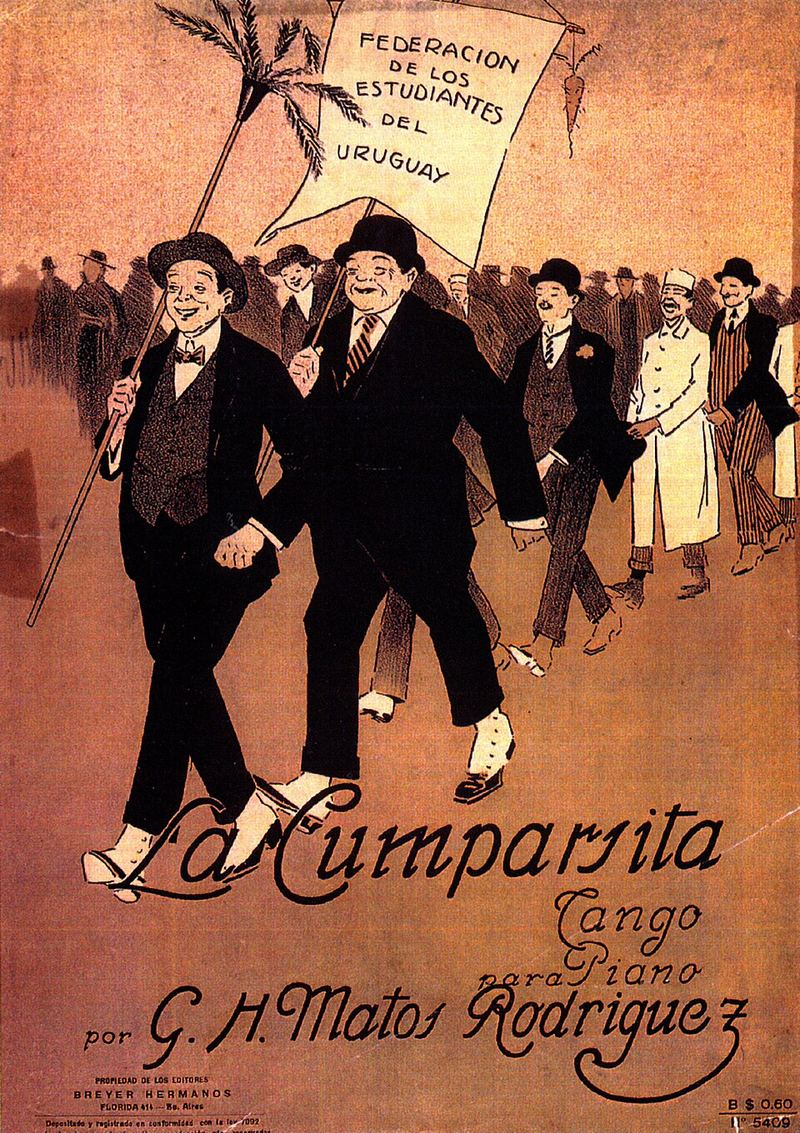
La Cumparsita began as an instrumental march for a students' carnival group, became a hit only once it had words, and gave rise to the longest authorship dispute in tango.
At a glance
- Composed by Gerardo Matos Rodríguez in Montevideo as a march for a students' carnival group; dated 1916 or 1917 depending on the source
- First sung on stage on 6 June 1924 with words by Pascual Contursi and Enrique Maroni (Si supieras); Matos wrote his own text in 1926
- The authorship dispute ended with Francisco Canaro's arbitration award of 10 September 1948, months after the composer's death
Fuente original: «Las letras de La Cumparsita» (Ricardo Ostuni, Revista Club de Tango n.º 43, 2000) · Resumen en español ↓
No tango is better known than La Cumparsita, and few have a more tangled history. A student’s carnival march, it faded after its first recordings and became a hit only when it was given words in 1924, without the composer’s consent. The quarrel that followed lasted a quarter of a century. In 2000 Ricardo Ostuni, a member of the Academia Nacional del Tango, told this story in Revista Club de Tango with a focus that is rarely taken: the tango’s several sets of lyrics. This page in our songs section follows his account and checks it against a legal study, Todotango and official Uruguayan sources. No lyrics are quoted here.
A march for a students’ carnival
The composer was Gerardo Hernán Matos Rodríguez, born in Montevideo on 18 March 1897, according to Orlando del Greco’s biography on Todotango. As a student he wrote a little march for the carnival group of the Federación de Estudiantes del Uruguay, and the students took it to Roberto Firpo, whose orchestra was playing at the café La Giralda in Montevideo. The early sheet-music cover shown on this page still pictures the students marching behind their banner.
Ostuni opens by saying that much remains unclear: the date of composition, Firpo’s part in the premiere, the passages he may have added, and who first wrote the music down. Some, he notes, credit the pianist Carlos Warren with the notation. The other sources show how wide the disagreement is:
- Ricardo García Blaya, in his history of the tango on Todotango, places the composition between late 1915 and early 1916 and says most researchers now date the first performances and recordings to 1916. He cites the historian Héctor Ernié, who found a first edition published in Montevideo by Arista y Lena in 1916 and a Buenos Aires edition by Breyer Hermanos in 1917. Others, among them Juan Carlos Legido and the composer’s grandniece, give 1917.
- The jurist Juan Montero Aroca, in a 2011 study in the journal Teoría y Derecho, dates the composition to late January or early February 1917, the parade to the carnival that began on 17 February 1917, and Firpo’s performance to March of that year.
- Uruguay’s official position is 1917. Law 16.905, promulgated on 2 January 1998, declared La Cumparsita the cultural and popular anthem of the country and gives its premiere as Montevideo, 19 April 1917; Law 19.464 named 2017 the year of its centenary, with the premiere at La Giralda.
Firpo’s contribution is also disputed. García Blaya writes that Firpo reworked the piece, using a passage of his own tango La gaucha Manuela for the trio, and that Matos, still a minor, refused to name him as co-author. Del Greco reports that Firpo himself made this claim at a tribute in 1966. Montero Aroca adds that Firpo never claimed any rights. Firpo’s own record, Odeón 483, is generally considered the first recording, according to García Blaya, followed by those of Juan Maglio and of the Alonso–Minotto orchestra. A few years later the bandoneon player Juan B. Guido spent several seasons in Firpo’s orchestra.
Sold, then forgotten
Matos sold the rights. Ostuni names the buyer as Breyer Hermanos, agents of the Ricordi house in Argentina. Montero Aroca dates the sale to April and May 1917, gives the price as 50 Argentine pesos, and notes that Ricordi took over Breyer’s catalogue in 1924. The tango soon dropped out of fashion. Ostuni quotes the writer Marambio Catán, who called it “totally forgotten” by 1924 (our translation), and explains why: without words, it had no place in the new fashion for the sung tango.
1924: Si supieras
On 6 June 1924, Ostuni writes, the company of Leopoldo Simari opened a short play by Pascual Contursi and Enrique Maroni, Un programa de cabaret, at the old Teatro Apolo in Buenos Aires. In its second scene the singer Juan Ferrari sang new verses to the music of La Cumparsita for the first time. García Blaya gives the same date and the title the lyricists chose, Si supieras. The play ran only briefly, but the song caught on: Carlos Gardel sang it that year and recorded it for Odeon with the guitarists Ricardo and Barbieri. Montero Aroca dates his second recording, made in Barcelona, to 10 January 1928.
Montero Aroca qualifies two points. He argues that the words were Contursi’s alone, which Maroni admitted, and that Contursi may have written and sung them years earlier in the Moulin Rouge, the Montevideo cabaret owned by the composer’s father. He also notes that the music was slightly altered to fit the verses, with the help of the play’s musical director, Antonio Scatasso.
The composer strikes back
Ostuni writes that Matos, then in Paris, heard of the new success from Francisco Canaro. With the help of a young Uruguayan lawyer, Dr. Calatayud, he set out to undo the sale and to forbid any words but his own. His lyric was registered at the Biblioteca Nacional on 9 November 1926 and recorded by the singer Roberto Díaz with the orchestra Los Provincianos. Montero Aroca, who studied the documents, describes the legal basis: a contract with Ricordi of 2 September 1926, under which Matos regained some rights and undertook to write a lyric. Julio Nudler, in his Todotango biography of Contursi, adds that Matos also restored the original title. Later singers of the Matos lyric included Tito Schipa in 1930 and Ángel Vargas with Ángel D’Agostino’s orchestra on 2 November 1945 (García Blaya).
The longest dispute in tango
Pascual Contursi died in 1932. Ostuni gives the date as 16 March; Nudler gives 29 May. According to Ostuni, his widow, Hilda Briano, and Maroni then sued Matos for damages and for recognition as co-authors. Montero Aroca supplies the details: years of letters and telegrams, a ban sent by Matos to the authors’ society SADAIC and to Odeon in June 1942, which mainly hit Gardel’s 1928 record; a lawsuit filed in 1946 by Hilda Briano, her son José María Contursi and Maroni; and a second claim in 1947 by José Razzano, Gardel’s former partner, who by then held the rights in Gardel’s repertoire.
Matos died on 25 April 1948 (Del Greco; Montero Aroca), with neither case decided. The parties then agreed to submit to the arbitration of Canaro, president of SADAIC. His award of 10 September 1948, accepted the same day, divided the performing, mechanical and film rights. Ostuni adds that future editions had to print both lyrics, that of Contursi and Maroni and that of Matos, and no others. Montero Aroca summarises the shares: the lyricists received 20 per cent of the performing rights even when the tango is played without words. Because the publisher Ricordi had not been a party, a clarifying agreement followed on 10 December 1952. The dispute also left a mark on the law: according to Montero Aroca, Argentina’s 1997 extension of copyright to 70 years after the author’s death, Law 24.870, was nicknamed the “Cumparsita law”, because the rights in the tango would otherwise have expired in 1998. Uruguay’s 1998 law, for its part, honours the music only, not any of the lyrics added to it.
The other lyrics
Canaro’s award prompted Ostuni to ask whether other lyrics existed. He found at least three more. The oldest, by Alejandro del Campo, a fellow member of the students’ federation, was printed in the magazine El Alma que Canta in 1926; Ostuni suspects that Matos commissioned it after the writer Víctor Soliño failed to deliver one. A second was by the poet and playwright Augusto Mario Delfino, mentioned in notes by Nicolás Olivari that El Alma que Canta published in 1957. Both evoke a carnival group and lost youth, and neither was ever recorded. The last is in English: The Masked One, by Olga Paul, which Roberto Selles dated to 1937 and attributed to the New York publisher Edward B. Marks. It did reach the record: the Discography of American Historical Recordings lists a Victor session in New York on 27 September 1939 at which Dinah Shore sang La cumparsita in English with Xavier Cugat’s Waldorf-Astoria Orchestra, lyrics credited to Olga Paul.
Ostuni’s verdict on all of them is severe. Until about the 1940s, he writes, the words given to tangos were usually far weaker than the music, with exceptions such as Celedonio Flores, Enrique Cadícamo, Francisco García Jiménez and Enrique Santos Discépolo. La Cumparsita, he concludes, has lasted in spite of its lyrics. Its recordings are countless; García Blaya singles out six by Juan D’Arienzo’s orchestra between 1928 and 1971 and four by Astor Piazzolla.
Sources
- Ricardo Ostuni, “Las letras de La Cumparsita”, Revista Club de Tango n.º 43, July–August 2000. Archived copy (archive.org, 2013). Open questions about date, Firpo and notation (Carlos Warren); Marambio Catán; sale to Breyer Hermanos; 6 June 1924 premiere of Un programa de cabaret at the Apolo with Juan Ferrari; Gardel’s 1924 Odeon recording with Ricardo and Barbieri; Canaro telling Matos in Paris; Dr. Calatayud; Matos lyric registered 9 November 1926, recorded by Roberto Díaz; Contursi’s death (16 March 1932); the lawsuit and Canaro’s award of 10 September 1948; the lyrics of Del Campo, Delfino and Olga Paul; his verdict on tango lyrics.
- Juan Montero Aroca, “El arbitraje sobre reparto de los derechos de propiedad intelectual de La cumparsita”, Teoría y Derecho no. 10 (2011), pp. 333–351. Composition and carnival in early 1917, sale in April–May 1917 for 50 pesos, Ricordi’s purchase of Breyer (1924), the 1926 contract, authorship of the lyric, Scatasso’s adjustment of the music, Gardel’s Barcelona recording (10 January 1928), the 1942 ban, the lawsuits of 1946 and 1947, Matos’s death (25 April 1948), the award and its shares, the 1952 agreement, Law 24.870.
- Ricardo García Blaya, “La cumparsita”, Todotango. Dating views (Ernié, Legido, Lucci, López, Binda), Firpo’s arrangement and La gaucha Manuela, first recordings (Firpo Odeón 483, Maglio, Alonso–Minotto), Si supieras and the 6 June 1924 premiere, Gardel 1924 and 1928, the Matos lyric of 1926 with Schipa (1930) and Vargas–D’Agostino (2 November 1945), D’Arienzo and Piazzolla recordings.
- Orlando del Greco, “Gerardo Matos Rodríguez”, Todotango. Birth (18 March 1897, Montevideo) and death (25 April 1948), the students’ march, La Giralda, Firpo’s claim of 1966, Un programa de cabaret at the Apolo.
- Julio Nudler, “Pascual Contursi”, Todotango. Contursi’s dates (18 November 1888 – 29 May 1932), the cabaret of Emilio Matos, Si supieras (1924), Matos’s own lyric and the restored title.
- República Oriental del Uruguay, Ley 16.905 (promulgated 2 January 1998) and Ley 19.464 (promulgated 23 December 2016), IMPO. Declaration as cultural and popular anthem (music only), premiere date 19 April 1917 at La Giralda, centenary year 2017.
- Discography of American Historical Recordings, “Victor matrix BS-042740. La cumparsita / Dinah Shore; Xavier Cugat Waldorf-Astoria Orchestra”. English version, lyricist Olga Paul, New York, 27 September 1939.