Charlo on the Radio: "Old Tango for Dancing, New Tango for Singing"
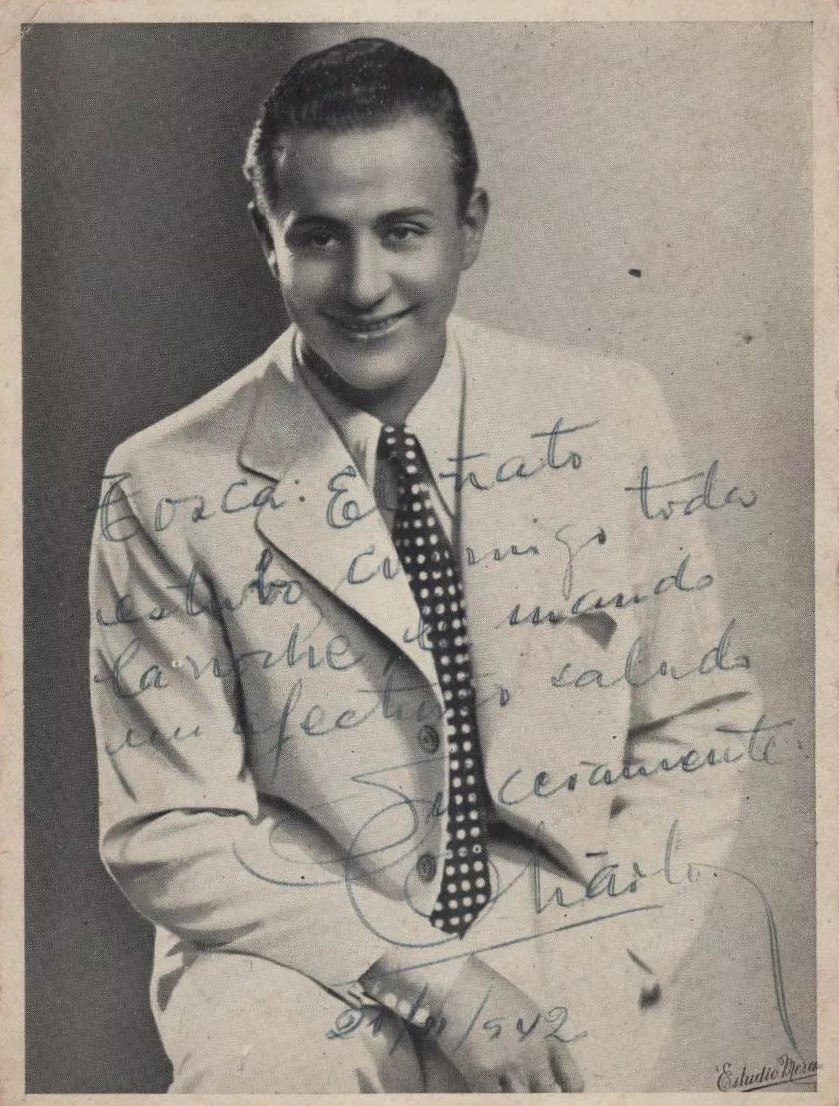
Interviewed on Radio Belgrano by Héctor Bates, Charlo told how a bank clerk who kept arriving late became the singer of a thousand sweethearts, and why he preferred old tangos for dancing.
At a glance
- Born Carlos José Pérez on 7 July 1906 in La Pampa, according to Julio Nudler; he himself told Héctor Bates he was born in Puán; died on 30 October 1990
- Singer, pianist, composer and actor; first broadcast on Radio Cultura, first records in 1925
- Composer of Pinta brava, Rencor, Cobardía and Tormento, among others
Fuente original: «Las entrevistas con Bates: Charlo» (Las entrevistas con Bates, Revista Club de Tango, 1994) · Resumen en español ↓
Charlo was one of the great tango artists of the late 1920s and 1930s, a pianist and composer as well, and the singer who made more records than any other, according to the tango writer Julio Nudler. In the 1930s the radio journalist Héctor Bates invited a series of tango performers to the microphone of Radio Belgrano. Charlo was the second; the series also included Tita Merello. The conversation was printed at the time and reprinted in Revista Club de Tango in December 1994; the reprint does not give the original date. It is a lively portrait of the singer in his own words, and the basis of this page. Facts from other sources are attributed in the text.
A pupil who would not study
Charlo told Bates that he was born in Puán, in the province of Buenos Aires, went to school there up to sixth grade and was then sent to the Internado Nacional, a boarding school in La Plata. He described himself as terribly lazy. His father grew tired of paying for nothing, took him out of school and found him a job in a bank. It lasted four months: his superiors got tired of seeing him arrive late.
Nudler’s Todotango biography gives a slightly different picture. He places Charlo’s birth on 7 July 1906 at a farm called La Piedad, between the railway stations of Guatraché and Avestruz in La Pampa, and says Charlo studied piano at a conservatory in Puán, went to secondary school in La Plata and briefly studied law. The family moved to Buenos Aires in 1922.
Music first
The one thing he did gladly as a child, Charlo said, was music. He had a piano teacher from the age of eight and later taught himself the guitar. He also told the listeners he was learning a new and unusual instrument, but would not say which: it was to be a surprise.
Because he sang well, he was always invited to family gatherings. There he met Enrique del Ponte and De Bary, who invited him to broadcast on Radio Cultura, then based on Avenida Alvear. His first broadcast was a piece for two pianos with Ángel Pozzi, known at the time as Wells. Then he sang, accompanying himself, and began to be known as a composer as well. Nudler dates this radio debut to 1924.
Carlos Pérez becomes Charlo
In the interview Charlo gives his real name as Carlos J. Pérez de la Riestra. Because the name was so long, he said, Del Ponte shortened it to “Charlo” when he announced him, and it stuck. Nudler questions both parts. In his account the singer’s name was simply Carlos José Pérez; he added “de la Riestra” himself, and biographies took it at face value. The stage name, adopted in 1924, came according to Nudler from “Charlot”, the French name for Charlie Chaplin’s tramp.
His first tangos
Charlo told Bates that his first tango was Sin cariño, from 1924, followed by No me olvides in 1926, then Pinta brava, Rencor, Cobardía, Tormento, Santa Lucía and Lindo tipo de varón. Nudler calls Pinta brava, which Charlo introduced in a musical at the Teatro de la Comedia, his first tango.
His first guitarists, he said, were Spina and Correa, followed by Iglesias Yriarte and Besada, his first guitarist at the time of the interview. Nudler confirms the start: in 1925 Charlo made his first ten records for the Electra label with Vicente Spina and Miguel Correa on guitar. His recording career ran until 1967, but most of it dates from 1928 to 1931, when he recorded for Odeon with Francisco Canaro’s orchestra.
The singer of a thousand and one sweethearts
Radio journalists called Charlo “the singer of a thousand sweethearts”. On air he told a story he had kept to himself. For a year he received perfumed letters, beautifully written, each with a small piece of a photograph: a hand one day, part of a face the next. He kept the pieces until he had the whole picture, a lovely girl of about eighteen. At last she agreed to meet him on a street corner, where she would wait in a car. A fine private car was waiting. Inside sat a lady who looked exactly like his grandmother, in face and in age, with a gold chain wound some twelve times around her neck. Bates proposed adding one to the count: from then on Charlo would be “the singer of a thousand and one sweethearts”.
Old tango for dancing
What makes the interview interesting for dancers today is Charlo’s view of the tango of his time. For dancing he preferred the old tango; for singing, the new. Some arrangers, he said, wanted to improve the tango and harmed it instead, writing orchestrations with so little feeling for the rhythm that the result was no longer tango. So many new tangos were being written, and so many of them bad, that he often fell back on old ones for his repertoire. He blamed publishers who printed every scrap of paper brought to them. The public, he warned, was coming to believe that tango was in decline, when in fact it was being poisoned by bad material.
Later years
Nudler adds what came after. Charlo’s film career began in 1935 with El alma del bandoneón, followed by starring roles in Puerto Nuevo (1936) and Carnaval de antaño (1940). He worked with orchestras including those of Roberto Firpo and Francisco Lomuto, and later with guitarists such as Roberto Grela and Edmundo Rivero, then at the start of his career. He died on 30 October 1990.
Sources
- “Las entrevistas con Bates: Charlo”, radio interview by Héctor Bates on Radio Belgrano, reprinted in Revista Club de Tango no. 12, December 1994. Archived copy on clubdetango.com.ar (archive.org, 2009).
- Julio Nudler, “Charlo”, Todotango (birth and death dates, birthplace in La Pampa, the name Carlos José Pérez and “de la Riestra”, origin of the stage name, radio debut in 1924, Pinta brava as first tango, Electra records of 1925 with Spina and Correa, Odeon years with Canaro, recording career to 1967, films, later partners).