Emilio Balcarce: The Arranger Who Wrote La bordona
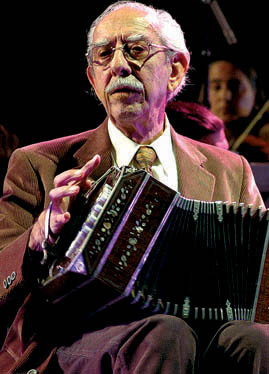
Emilio Balcarce led orchestras for Alberto Castillo and Alberto Marino, shaped the sound of Osvaldo Pugliese's orchestra for twenty years and wrote La bordona.
At a glance
- Born Emilio Juan Sitano in Buenos Aires on 22 February, in 1918 according to Alberto Heredia, in 1920 according to Revista Club de Tango and La Nación; died on 19 January 2011
- Violinist and arranger in Osvaldo Pugliese's orchestra from 1949 for about twenty years; co-founder of Sexteto Tango in 1968
- Composer of La bordona, recorded by Aníbal Troilo, and Bien compadre, recorded by Pugliese on 27 September 1949
Fuente original: «Emilio Balcarce» (Revista Club de Tango, 1997) · Resumen en español ↓
Emilio Balcarce rarely stood in the spotlight, yet few musicians shaped the tango that dancers hear today as much as he did. He was a violinist, a self-taught bandoneonist, a bandleader and, above all, an arranger: for twenty years his orchestrations helped define the sound of Osvaldo Pugliese’s orchestra. In 1997 Revista Club de Tango published a portrait of him, then still working at 76, that called him a complete and essential artist who knew how to evolve without losing the essence of tango. It would have been enough, the article says, to write La bordona to earn a place in tango history. This page follows that article; facts from other sources are attributed in the text.
Two birth years
The magazine gives his birth as 22 February 1920 in Buenos Aires, and La Nación used the same date in a 2000 interview. Alberto Heredia’s biography on Todotango gives 22 February 1918 and his real name, Emilio Juan Sitano. In an interview with Alberto Rasore and José Pedro Aresi, also on Todotango, Balcarce said he was born and raised in Villa Urquiza and still lived there.
From the violin to his own orchestra
According to the magazine, he studied violin with the teachers Paiva and Marcoli, and counterpoint, harmony and fugue with Professor Elher. He told Rasore and Aresi that he had to stop his violin lessons at 13 because his family could no longer afford them. Around 1935 he joined the group of Ricardo Ivaldi.
In 1940 he formed his own group and switched to the bandoneon, which he taught himself; the instrument helped him think harmonically as an arranger. Later he returned to the violin in the orchestra of Edgardo Donato. When the singer Alberto Castillo left Ricardo Tanturi’s orchestra to go solo, Balcarce put together the orchestra that accompanied him. Balcarce himself dated this to 1943 and said it lasted a year. That was when his name became known: the orchestra was a great success at the carnival dances, then on Radio Belgrano, and it recorded. The magazine singles out Mano blanca, Anclao en París, Charol and Amarras with Castillo.
After Castillo, Balcarce led the orchestra under his own name and hired the singer Jorge Durán; later he shared the vocal duties with Amadeo Mandarino, who in 1939 had been Pugliese’s first singer. Then Alberto Marino, on leaving Aníbal Troilo’s orchestra, entrusted him with the arrangements and direction of his orchestra. The magazine places this in 1940, which cannot be right, since in its own account it comes after the Castillo years. Heredia confirms that Balcarce formed this orchestra at Marino’s request. With Marino he recorded Organito de la tarde, El motivo and Qué habrá sido de Lucía, among others.
La bordona
After Marino, Balcarce spent two years working only as an arranger, for Troilo, Alfredo Gobbi and Leopoldo Federico; Heredia adds Francini–Pontier and José Basso. His own masterpiece was La bordona. The magazine says Troilo recorded it in 1956; Heredia writes that Balcarce delivered the orchestration to Troilo in 1958. Both call it his most important work. The magazine explains why it is still studied: it is orthodox tango that tries out modern ideas without any show of revolution, with a beautiful melody, a rhythmic second part, careful harmony and room for piano, bandoneon and violin to phrase and sing. Balcarce told Rasore and Aresi that of all his compositions, it was the one that satisfied him most.
Twenty years with Pugliese
In 1949, as the brilliant decade of tango came to an end, Pugliese called him. The magazine lists the orchestra: Camerano, Herrero, Carrasco and Balcarce on violins; Ruggiero, Gilardi, Caldara and Castagniaro on bandoneons; Aniceto Rossi on double bass; Pugliese at the piano. Balcarce brought two talents, as player and arranger, and absorbed the style of Pugliese and Osvaldo Ruggiero. Pugliese quickly took up his compositions too, recording his tango Bien compadre on 27 September 1949.
Balcarce stayed about twenty years, becoming second violin (Herrero was first chair from 1955). With Julián Plaza and Pugliese himself, and Ruggiero in the early years, he shaped the style through the arrangements. The magazine lists his most important work for the orchestra: El tobiano (1950), Pasional (1951), Si sos brujo (1952), Caminito soleado (1953) and Por una muñeca (1954) for Odeon, and Nonino (1962), Candombe blanco (1962) and Cardo y malvón (1963) for Philips. Dancers who love Pugliese’s 1950s recordings are listening, in part, to Balcarce.
Sexteto Tango and later years
In 1968 he left Pugliese together with Plaza, Ruggiero, Rossi, Herrero, Víctor Lavallén and the singer Jorge Maciel to form Sexteto Tango. Its style, according to the magazine, was close to Pugliese’s but distinct. The sextet recorded for RCA Victor and toured Japan, the Soviet Union, France, Spain and South America. In the 1970s it played at El Viejo Almacén with its host, Edmundo Rivero, and also worked with the singer Roberto Rufino. In 1997, at 76, Balcarce was arranging for the group Color Tango and still playing with a renewed Sexteto Tango.
There was more to come. From 2000, as Heredia and the 2000 La Nación interview describe, he led the Orquesta Escuela de Tango, a school orchestra proposed by Ignacio Varchausky to teach young musicians the styles of the 1940s orchestras. Heredia names its two discs, De contrapunto and Bien compadre. Emilio Balcarce died on 19 January 2011; he is remembered as one of the great tango artists who worked mostly behind the scenes.
Sources
- “Emilio Balcarce”, Revista Club de Tango no. 26, September–October 1997. Archived copy on clubdetango.com.ar (archive.org, 2012).
- Alberto Heredia, “Emilio Balcarce”, Todotango (real name, birth date 1918, death date, the Marino orchestra, arrangements for Francini–Pontier and Basso, La bordona in 1958, Orquesta Escuela de Tango and its discs).
- Alberto Rasore and José Pedro Aresi, “Interview to Emilio Balcarce”, Todotango (Villa Urquiza, violin lessons until 13, Castillo orchestra from 1943, La bordona as his favourite composition).
- “Ese joven de 83 años”, La Nación, 6 November 2000 (birth date 22 February 1920, the Orquesta Escuela de Tango).