Phonograph vs Gramophone: How Cylinders and Discs Reached Tango
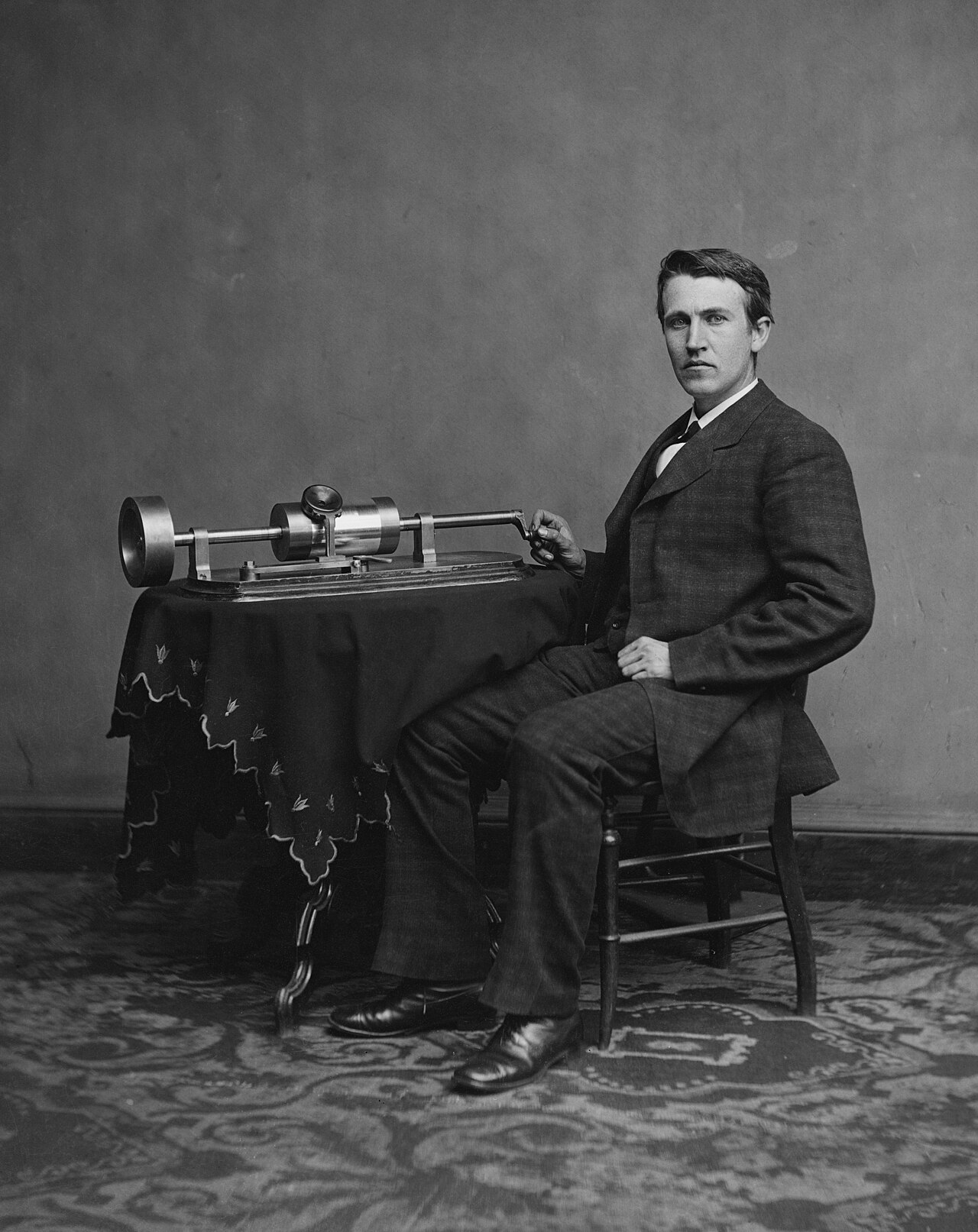
Edison's phonograph and Berliner's gramophone fought for the market for half a century, and both reached Buenos Aires in time to record the first tangos.
At a glance
- Edison recorded on tinfoil in 1877; Emile Berliner patented the first gramophone inventions, for flat discs, in November 1887
- One disc master could be pressed into thousands of copies, while early cylinders had to be recorded over and over again
- The phonograph was shown in Buenos Aires in 1878; the first locally recorded criollo discs went on sale there in 1902
Fuente original: «El fonógrafo vs. el gramófono» (Héctor Lucci, Club de Tango, 2001) · Resumen en español ↓
Every tango recorded before about 1930 was captured by one of two machines: Thomas Edison’s phonograph, which cut sound into a rotating cylinder, or Emile Berliner’s gramophone, which cut it into a flat disc. The tango collector Héctor Lucci, whose private collection held both cylinders and discs, told the story of their rivalry in a short essay for the old Club de Tango website in 2001. This page summarises his account, checks the dates against the Library of Congress, the Smithsonian, the National Park Service and the University of California, Santa Barbara, and follows both machines to Buenos Aires, where they shaped the first chapter of recorded tango history.
Edison’s cylinder
Lucci starts with Edison, the first to build and patent a way of recording sound and playing it back at will, in 1877. The National Park Service, which looks after Edison’s laboratories, confirms that his first recordings were made on sheets of tinfoil at Menlo Park, New Jersey, in 1877. Lucci counts three recording materials in the following thirteen years: tinfoil, a waxed cardboard tube and, around 1890, the solid wax cylinder that launched the record trade. The Park Service dates Edison’s solid wax cylinder to 1888, developed at West Orange.
Berliner’s disc
While the cylinder camp argued over patents and licences, Berliner, a German immigrant living in Washington, took a different route. Lucci dates his patent to 1888; the Smithsonian and the Discography of American Historical Recordings (DAHR) both place his first gramophone patents in November 1887, with a public presentation at the Franklin Institute in 1888. The difference, as Lucci explains, was twofold: the sound was carried by a flat disc instead of a cylinder, and the groove moved from side to side (lateral cut) instead of up and down, the “hill-and-dale” cut of the cylinder.
Why the disc won
For Lucci the decisive point was copying. A single recording of a disc gave a master from which thousands of copies could be pressed. With cylinders, he writes, making 500 copies meant performing the same piece 25 times in front of 20 phonographs at once. The Smithsonian describes the same contrast: Berliner made a master, a mould from the master and then pressed as many discs as he liked, while the first cylinders could only be multiplied by making more originals. UCSB’s cylinder archive adds that performers sang or played for hours in front of several horns, until Edison’s moulding process of 1902 finally allowed cylinders to be duplicated from a master.
The disc had its own troubles. Lucci notes that Berliner’s first commercial discs were made of hard rubber, which he called vulcanite: 5-inch discs recorded in 1894 and 7-inch ones offered in a stock list of November 1894. DAHR, in Paul Charosh’s introduction to the Berliner discography, confirms that the first surviving list of gramophone discs for sale dates from 1894 and mentions a “list of plates in stock” of November that year. Rubber discs sounded weaker than wax cylinders, and sales were slow. According to Lucci, a trial pressing at a button factory solved the problem: the factory’s material was based on shellac, which remained the stuff of 78 rpm records to the end. The Smithsonian names Berliner’s shellac compound, Duranoid, and says the industry used such compounds until the late 1940s, by which time the laterally cut disc at 78 rpm had become the standard.
Edison’s long resistance
Lucci follows the next steps on both sides. In May 1902 the Gramophone Company put on sale its first ten discs by Enrico Caruso, recorded in Milan; it was these records, he argues, that persuaded famous singers to record. Caruso is also one of the voices on a collector’s CD about the Teatro Colón. Columbia gave up cylinders for discs; UCSB dates its last cylinders to 1909.
Edison fought back. According to Lucci, his two-minute wax cylinder of 1902 had to compete with discs that already played for three minutes, and with 12-inch discs of four minutes by 1904. UCSB confirms the counter-moves: the four-minute wax Amberol cylinder in 1908 and the unbreakable celluloid Blue Amberol in 1912. Lucci adds that the celluloid cylinder was guaranteed for 3,000 playings. Edison finally made discs himself, the Diamond Disc, which kept the vertical cut. Lucci dates it to 1913, the National Park Service to 1912, and UCSB has the company making discs “by 1915”. All agree on the end: Edison went on making cylinders until 1929, and UCSB specifies that he left the record business in October 1929, days before the stock-market crash.
The machines in Buenos Aires
In a separate article on Todotango, Lucci traced how the inventions arrived in Argentina. The phonograph was shown in Buenos Aires as early as 1878, at Florida 347, for an admission of 20 pesos. Only two Edison machines arrived in 1891, followed two years later by a larger shipment with 400 cylinders, and showmen toured the capital and the provinces charging one peso for eight listeners. Berliner’s company recorded what Lucci calls the first Argentine number, the national anthem sung by the Italian tenor Arturo Adamini, in 1897, and gramophone discs went on sale in the city from then on.
The decisive step came in 1902. The Casa Repetto registered the Royal Record trademark on 24 July 1902 and announced discos criollos: Argentine music recorded in Buenos Aires, with the matrices sent to Europe and a test pressing returned for approval. The tango researcher Enrique Binda, in a note added to Lucci’s article, places the first sales in August 1902. In another Todotango article Lucci describes these first criollo discs as about 7 inches across, single-sided and lasting one and a half to two minutes, and notes a nice sign of the rivalry: the reciter Eugenio Gerardo López recorded El gaucho y el fonógrafo for Edison in 1902 and El gaucho y el gramófono for Victor in 1906. UCSB’s catalogue shows that Edison even ran an Argentine series among its four-minute Amberol cylinders.
What it meant for tango
The first tangos on record were shaped by these limits: two minutes or so of music, a single voice with guitar or piano, a horn instead of a microphone. Within those limits the first tangos on disc were sung by singers and payadores such as Ángel Villoldo, Gabino Ezeiza and Higinio Cazón, whose tango El taita was recorded on a Zonophone disc in 1905 with Manuel Campoamor at the piano. Lucci ends his essay without a winner: more than a century later, a few drops of oil for the machine and a wash in cold water and soap for the record are enough to make cylinders and discs sound again as they did for our grandparents.
Sources
- Héctor Lucci, “El fonógrafo vs. el gramófono”, Club de Tango, 2001. Archived copy on clubdetango.com.ar (archive.org, 2009).
- National Park Service, Thomas Edison National Historical Park, “The Recording Archives” (tinfoil recordings at Menlo Park 1877, solid wax cylinder at West Orange 1888, Diamond Disc 1912, record production until 1929).
- Smithsonian Music / National Museum of American History, “Berliner Gramophone Record” (patent of November 1887, mass production from master and mould, vertically cut cylinders, Duranoid shellac until the late 1940s, lateral 78 rpm standard).
- Paul Charosh, “Introduction: On the Gramophone”, in Berliner Gramophone Records: American Issues, 1892–1900, Discography of American Historical Recordings, UC Santa Barbara (first patents 1887, Franklin Institute 1888, first disc list 1894, November 1894 stock list).
- UCSB Cylinder Audio Archive: “Edison Gold-Moulded Cylinders” (recording by repetition, moulding process 1902), “Edison Amberol Cylinders” (four-minute cylinder 1908, Argentine series), “Edison Blue Amberol Cylinders” (celluloid 1912, Columbia’s last cylinders 1909, Diamond Disc by 1915, end in October 1929).
- Héctor Lorenzo Lucci, “The phonograph in Buenos Aires and the early discs with criollo numbers”, Todotango, with a note by Enrique Binda (Buenos Aires 1878, 1891, 1893, Adamini 1897, Royal Record 24 July 1902, first sales August 1902).
- Héctor Lorenzo Lucci, “The itinerant singers (payadores) and the early recordings in Buenos Aires”, Todotango (size and length of the first criollo discs, López’s El gaucho y el fonógrafo and El gaucho y el gramófono).