Gardel and Razzano in Azul, 1922: A Tour Told in Letters
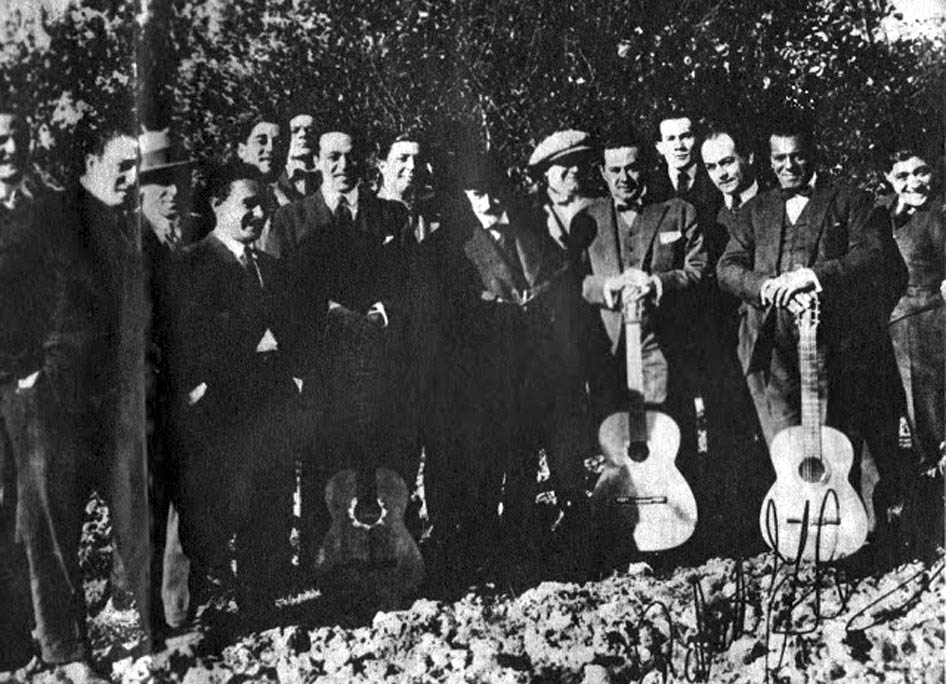
Four letters kept by a provincial theatre in Azul show the Gardel–Razzano duo's manager haggling over dates, posters and tickets for two nights in April 1922.
At a glance
- Carlos Gardel and José Razzano sang at the Teatro Español in Azul on Saturday 15 and Sunday 16 April 1922
- Four letters from their manager César Chicchi to the theatre's impresario Pedro Ortiz, dated 13 March to 6 April 1922, survive in the theatre's archive
- The guitarists José Ricardo and Guillermo Barbieri were added at the last minute, so the duo's party needed five travel tickets instead of four
Fuente original: «Por seguir tras de su huella... Carlos Gardel, símbolo folklórico del Río de la Plata» (Revista Club de Tango n.º 42, 2000) · Resumen en español ↓
Fuente original: «Por seguir tras de su huella... Gardel en Azul 1922» (Revista Club de Tango n.º 43, 2000) · Resumen en español ↓
Fuente original: «Gardel en Azul, 1922 (II)» (Revista Club de Tango n.º 44, 2000) · Resumen en español ↓
Fuente original: «Gardel en Azul, 1922 (II) [tercera entrega]» (Revista Club de Tango n.º 45, 2000) · Resumen en español ↓
In April 1922 Carlos Gardel and José Razzano spent a weekend in Azul, in the province of Buenos Aires, and sang two nights at its Teatro Español. Nobody had written about the visit until Ana María Turón, a researcher from Azul, went through the old papers of the theatre and found the letters that had prepared it. She presented them in Revista Club de Tango in 2000, in a series called Por seguir tras de su huella (“To follow in his footsteps”), which opened with an essay on what Gardel means to Argentines. This page brings the four instalments together, summarises the letters in our own words, and adds context from independent sources. It belongs to our section on tango artists.
Gardel as a symbol
Turón’s essay, printed in issue 42 (May–June 2000), sets Gardel beside Martín Fierro, the gaucho of José Hernández’s poem. In her reading they are the two model singers of Argentine popular culture: one invented, rural and of the nineteenth century, the other real, urban and of the twentieth. She follows the themes they share, among them the mother, the neighbourhood or the pampa as a refuge, pain as a man’s lot, the horse and the races, the guitar, false friends, drink and poverty, and the places where they part. The gaucho resigns himself and fears God; the man of the tango hardly thinks of God and turns to his mother instead.
The main difference, she argues, lies in how the public treats them. Martín Fierro is a traditional figure whose words nobody would dare to change. Gardel is a folk figure: people put sayings in his mouth and invent episodes of his life. She compares him with other Argentine idols of the century, Yrigoyen, Perón, Evita and Maradona, and finds that each is admired by one group or in one field, while Gardel is admired in every respect and has become a superlative. To say sos Gardel, “you’re Gardel”, needs no addition. For Turón he is therefore less a myth than a symbol that unites the centre and the barrio, natives and immigrants, rich and poor.
The duo on the road
Gardel and Razzano began singing together in 1911, according to Pablo Taboada’s biography of Gardel on Todotango. Taboada describes a quartet with Saúl Salinas that toured the countryside of Buenos Aires province in 1913, the formal birth of the duo in December 1913, and, between 1918 and 1922, constant work in the theatres of Buenos Aires, Montevideo and towns across the interior. By 1921 the duo was accompanied by two guitarists, José Ricardo, who had joined around the end of 1915, and Guillermo Desiderio Barbieri. Ricardo later accompanied other singers on record, among them Anita Palmero. Horacio Loriente, in his Todotango profile of Razzano, notes that the duo’s recordings began in May 1917 and that by 1925 Razzano had damaged his vocal cords and stopped singing, staying on as Gardel’s secretary and agent.
Turón starts from the fact that these provincial tours can no longer be fully reconstructed. The witnesses are dead, and whole archives have been lost to floods and time. Of Azul, she writes, only one visit was known: Gardel’s performance at the Teatro Español on 16 May 1933. In the theatre’s own files she found more, including the 1922 engagement and other plans that came to nothing.
Four letters to Azul
The letters were written by César Chicchi, the duo’s representative, to Pedro Ortiz, the impresario of the Teatro Español, which belonged to the town’s Spanish society. Turón published them out of order, the latest first; here they follow the calendar.
13 March 1922, Buenos Aires. The oldest letter in the archive refers to earlier correspondence and is written on paper of the Teatro Artigas in Montevideo. Chicchi confirms the debut of Gardel and Razzano in Azul for 18, 19 and 20 April and urges Ortiz to advertise well, both at the Teatro Español and at the Cine San Martín of the same society, including lantern slides on the cinema screen. He signs with an address in Lavalle street, Buenos Aires.
16 March 1922, Buenos Aires. Ortiz had answered at once, on the 15th, and evidently asked whether the duo had a commitment with the cinema as well. Chicchi, now writing on the letterhead of the film company Cairo-Film, apologises for the misunderstanding. Gardel and Razzano, he assures him, will not sing in any other house in the town, before or after, and his only written contract is with the Teatro Español. He had suggested the slides only because he had been told the society’s theatre showed films during the week, and the Cine Bar San Martín because its president had said it belonged to the same body. Turón links the letterhead to the theatre businessman Humberto Cairo.
2 April 1922, Buenos Aires. Chicchi promises to send the printing blocks for the posters as soon as he can and asks that the hand programmes name Barbieri too. At the last moment, he explains, Gardel and Razzano have decided to bring their guitarists Ricardo and Barbieri again, so that the show can include a guitar concert. The party will therefore need five tickets, not four. Any objection can reach him in Bolívar, where he will be on 5, 6 and 7 April. The duo’s names at the foot were set with a small rubber stamp, a detail Turón finds touching.
6 April 1922, Bolívar. The last letter before the show is written on paper of the Gran Hotel Colón in Bolívar, which shows where the duo, its guitarists and the manager were staying. Chicchi sends a programme so Ortiz can see what the show is like, reports that the tour has begun with a huge success, and asks him to keep the publicity going. The dates have now moved forward: Saturday 15 and Sunday 16 April. In a postscript he apologises that the blocks have not come, through the maker’s fault. Turón found only the attached poster in the archive, not the programmes.
Between the first and the last letter, then, the dates changed from three nights, 18 to 20 April, to two, the 15th and 16th; Turón promised to tell the story of these changes in a later instalment. The calendar confirms the weekend: 15 April 1922 fell on a Saturday.
A town in the news two days later
Turón adds a grim footnote. Just two days after the duo left, Azul was in the national news because of the killings committed by Mateo Banks. According to Federico Trofelli in Tiempo Argentino (2024), Banks murdered eight people, most of them members of his own family, on 18 April 1922 at the family ranches in Parish, in the rural district of Azul. Turón imagines that the musicians, who had walked the town’s streets only hours before, must have talked about it.
A provincial archive
What makes the letters special, Turón says, is that they are unpublished, that almost nothing is known about the man who signed them, and that their spelling, shaped by his mother tongue, gives them an unpolished charm. They let a reader watch the routine of a star act on the road: a manager writing from one town to the next, juggling dates, worrying about posters, slides and fares, and reassuring a suspicious impresario about exclusivity. The series ends with the promise of more such details from the theatre’s papers. The Spanish-born authors in Gardel’s repertoire are the subject of our page on Gardel and the Spanish songwriters; for his last months, see our pages on his 1935 tour of Venezuela and on his last letter, his films and two debates.
Sources
- Ana María Turón, “Por seguir tras de su huella… Carlos Gardel, símbolo folklórico del Río de la Plata”, Revista Club de Tango no. 42, May–June 2000. Archived copy on clubdetango.com.ar (archive.org, 2009). The essay comparing Gardel and Martín Fierro.
- Ana María Turón, “Por seguir tras de su huella… Gardel en Azul 1922”, Revista Club de Tango no. 43, July–August 2000. Archived copy on clubdetango.com.ar (archive.org, 2007). Performances of 15 and 16 April 1922 and of 16 May 1933; letter of 2 April 1922; Mateo Banks reference.
- Ana María Turón, “Gardel en Azul, 1922 (II)”, Revista Club de Tango no. 44, September–October 2000. Archived copy on clubdetango.com.ar (archive.org, 2007). César Chicchi as the duo’s representative; letter of 6 April 1922 from Bolívar.
- Ana María Turón, “Gardel en Azul, 1922 (II)” [third instalment], Revista Club de Tango no. 45, November–December 2000. Archived copy on clubdetango.com.ar (archive.org, 2007). Letters of 13 and 16 March 1922; Ortiz’s reply of 15 March.
- Pablo Taboada, “Carlos Gardel”, Todotango (duo from 1911, 1913 tour of the province, Dúo Nacional from December 1913, José Ricardo from late 1915, Barbieri by 1921, work in the interior 1918–1922).
- Horacio Loriente, “José Razzano”, Todotango, from Ochenta notas de tango (Montevideo, 1998) (recordings from May 1917, Razzano’s damaged voice by 1925, his role as Gardel’s secretary and agent).
- Federico Trofelli, “Venden la casa de Mateo Banks, el mayor asesino múltiple del país”, Tiempo Argentino, 2 June 2024 (the killings of 18 April 1922 at the Banks ranches in Parish, Azul).